
Product
Nobody Counts Their Money in a Second Language
By Masanchara · · 8 min read
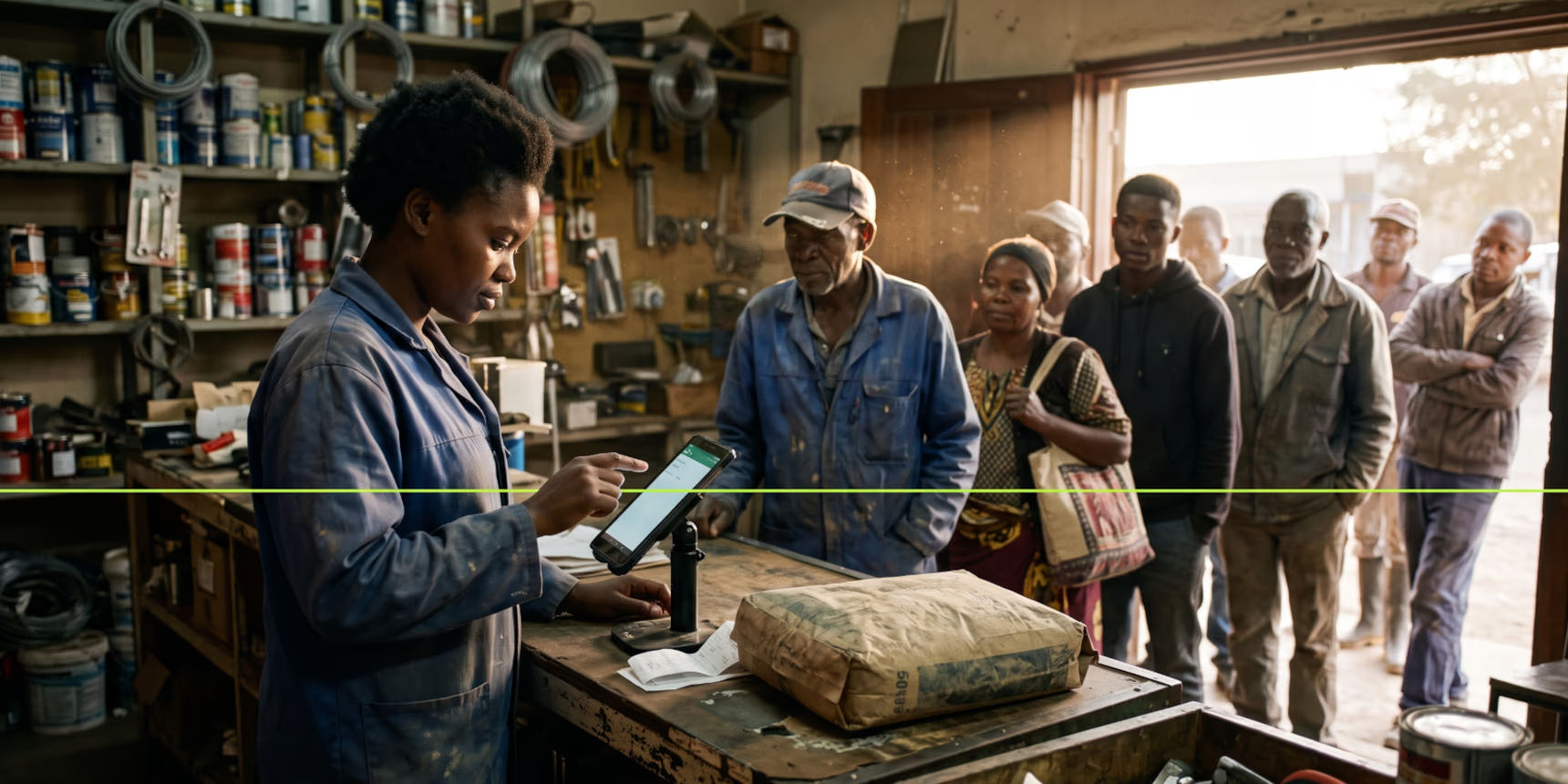
It is a Friday afternoon at a hardware counter in Bulawayo and the queue is six deep. Your cashier has been with you two years. She is quick, she is honest, and she can count change faster than you can.
A customer changes his mind about a bag of cement. She needs to take it off the sale.
The screen offers her two options. Void transaction — this reverses the sale and returns the stock to the shelf. And below it: Void line — this removes one item from the current sale.
She reads it. Then she reads it again. Behind her, six people are waiting and one of them sighs.
She taps the first one.
Now the whole sale is gone, the four items already rung up have to be scanned again, and the queue has grown to eight. It cost ninety seconds and a small piece of her confidence.
She is not a poor reader. She reads English perfectly well. She just does not read it at a glance.
The arithmetic of a second language
There is a difference between reading a language and recognising it, and a till is built entirely on the second one.
When you read a word in your mother tongue, you do not assemble it from letters. You recognise its shape, the way you recognise a face across a room. It costs you nothing. When you read a word in your second language — even one you speak fluently — a small translation job happens first. In a quiet room with a book, that job is invisible. It costs you a fraction of a second and you never notice.
Put that same fraction of a second under a queue, and it becomes visible.
At a counter, nobody reads. They glance. They hit the green button because it is where the green button always is. Their hands learn the screen and their eyes stop checking. That is not carelessness — that is what competence looks like, and it is exactly what you want from someone serving forty customers an hour.
But muscle memory only forms around shapes you recognise instantly. In a second language it forms slower, and it forms less reliably, and it breaks down precisely when the pressure is highest.
Which means the mistakes do not spread evenly across the software. They cluster on the screens where language carries the most weight and the stakes are highest. Void or refund. Discount or price override. Cash sale or credit sale.
The screens where a wrong tap costs you money are the same screens with the most words on them.
Twenty-two languages, and what that actually buys
Masanchara ships in twenty-two languages.
There is English, and the languages of the region — Shona, Ndebele, Swahili. There is the European set that trade and diaspora carry: French, Portuguese, Spanish, German, Italian, Dutch, Polish, Russian. There is South and Southeast Asia: Hindi, Indonesian, Malay, Thai, Vietnamese, Tagalog. And Arabic, Turkish, Japanese, Korean.
Add up everyone who speaks one of those as a mother tongue and you get roughly 2.7 billion people — about a third of everyone alive.
You will see bigger numbers quoted for lists like this. If you count second-language speakers too, the same twenty-two languages reach something above five billion, which is sixty percent of the planet, and it would look very good on a slide.
It is also a flattering lie, and it is worth explaining why.
Swahili has ninety-five million speakers. Four million of them learned it at home. The rest speak it as a second or third language — and a great many of those same people are counted again under English, and again under their own mother tongue. Modern Standard Arabic has three hundred and thirty-five million speakers and is nobody's mother tongue at all; it is the written and broadcast register, learned at school. English's one and a half billion is mostly the same trick: about a quarter of them grew up with it.
So the second number counts people who can work in a language. The first counts people who think in one.
For a book, or a news site, the bigger number is the honest one. For the screen where somebody decides whether to give a customer credit, it is not. We quote the smaller number.
The two that matter least, and most
Shona has around fourteen million speakers. Ndebele has around two and a half million.
Between them, that is roughly two-tenths of one percent of the world's population. On any ranking of languages worth translating software into, they do not appear.
They are also the entire reason this product exists.
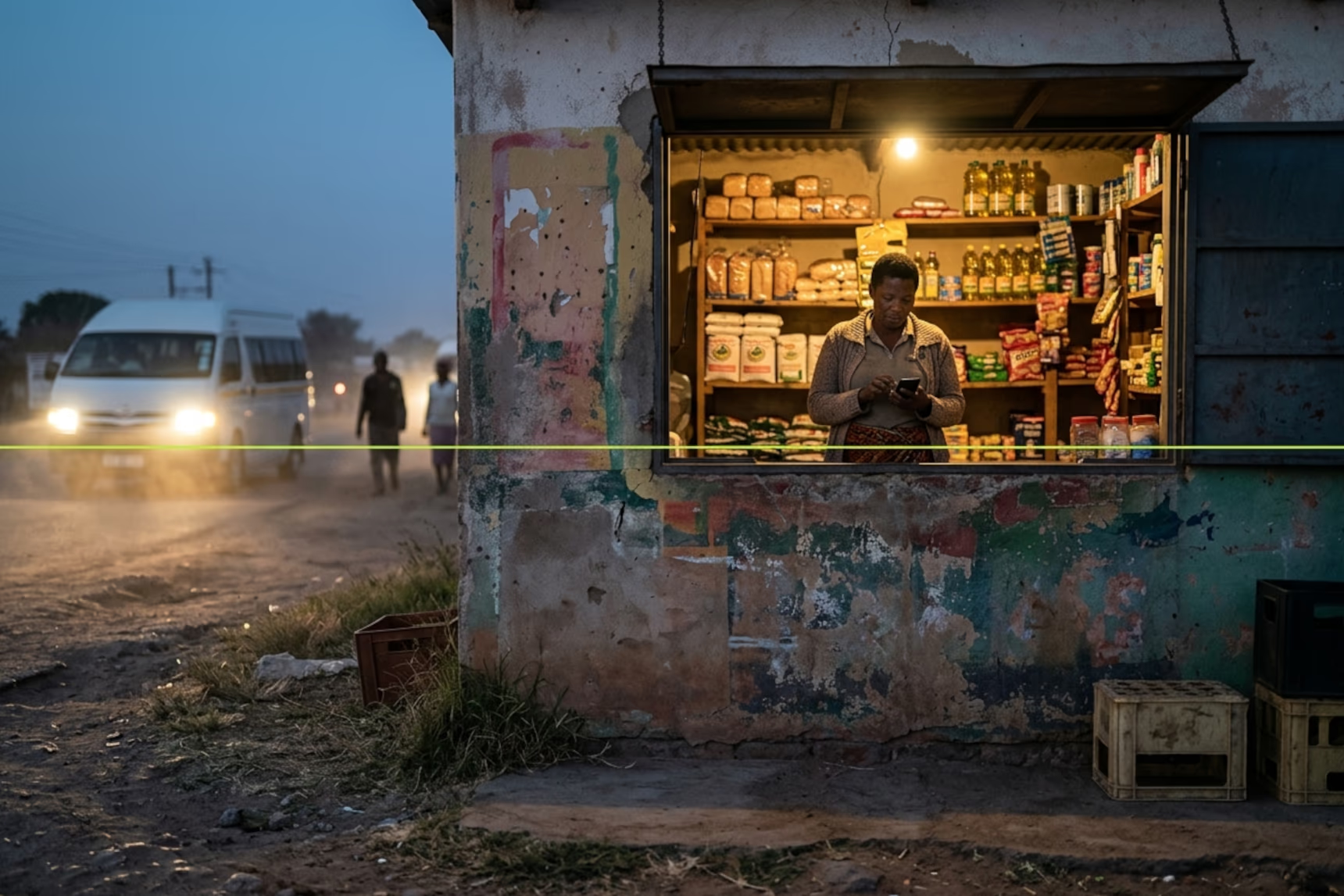
The shopkeeper in Mbare, the hardware trader in Bulawayo, the woman running a tuckshop off a main road in Gweru — they are not a rounding error in a market study. They are the customer. Every other language in the list is there because the same problem exists elsewhere and the work of solving it once was already done. These two are there because they are the point.
It is worth noticing which languages a business chooses to support when supporting them earns nothing. That choice tells you who the software was actually built for.
What "translated" actually costs
Translating software is not translating a document. A document is read once, in order, by someone who is sitting down. Software is glanced at, out of order, by someone standing up.
Four things make it hard, and none of them are the words themselves.
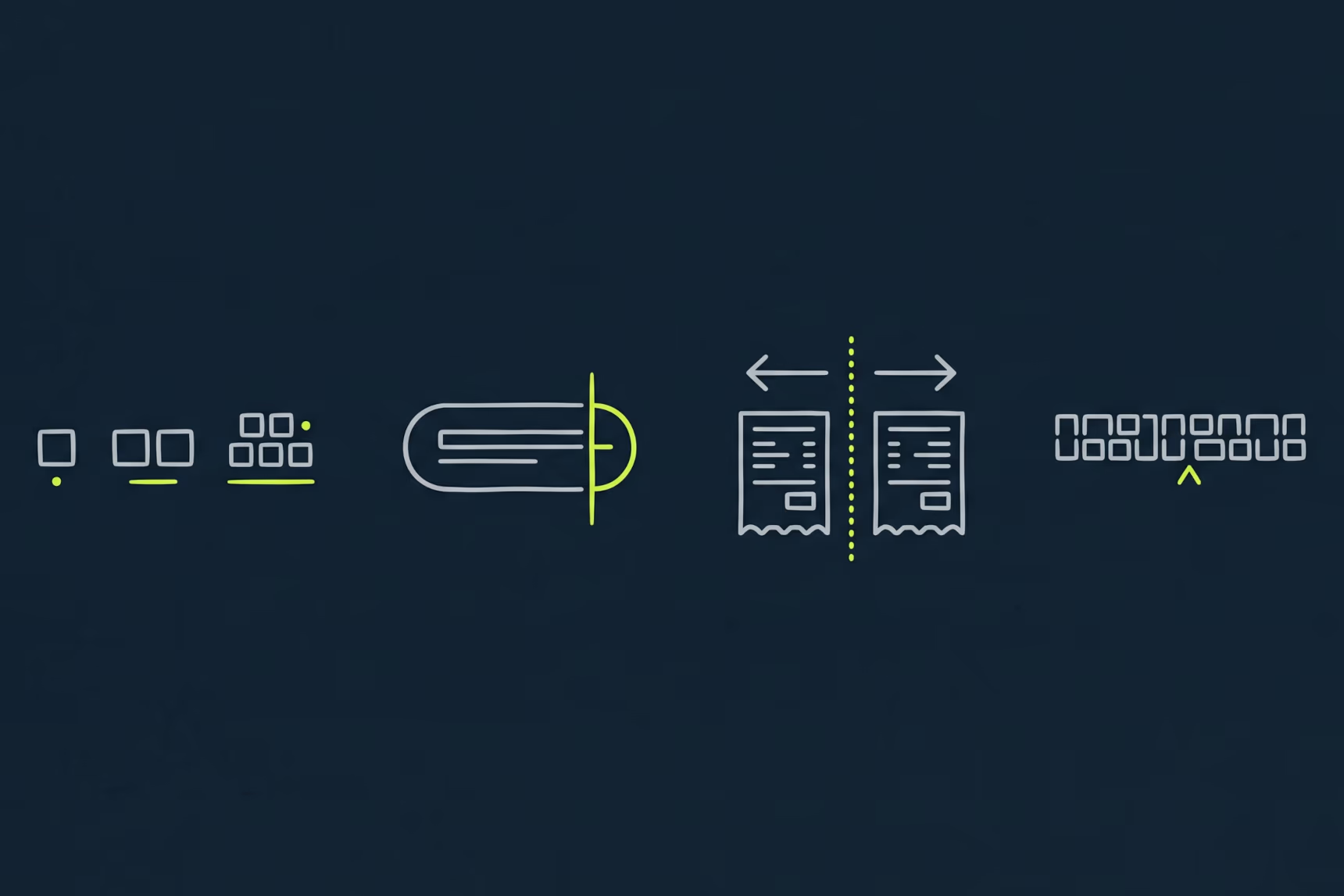
Counting is not universal. English has two forms — one item, two items. Russian has three. Arabic has six. A receipt that says "2 items" in English and gets a lazy translation says something subtly broken in half the world, and it says it on every single sale.
Buttons do not stretch. A button sized for the English word "Payables" has room for about fourteen characters. The Ndebele is eighteen. Something has to give, and if nobody decides what, the phone decides for you — usually by clipping the word in half, on the button that moves money.
Not every language runs left to right. Arabic mirrors the entire layout. The back arrow points the other way. The total moves to the other side of the receipt. This is not a translation problem at all; it is a layout problem wearing a translation costume.
Some languages do not use spaces. Thai and Japanese run words together. Every rule you wrote about counting characters and breaking lines was quietly written for English, and all of them are wrong.
And then there is the quiet one that nobody expects.
Sometimes the translation is already correct. "Total" is the French word for total. "Name" is the German word for name. "Code", "Details", "Status", "Minute" — a dozen words in every European language arrive already translated, because they were borrowed centuries ago and never changed.
A system that treats an unchanged word as a failure will re-translate those words forever. It will ask the same question every night and get the same right answer, and never once accept it. Every locale sits at ninety-eight percent for eternity, and the missing two percent is a list of words that were never missing.
That is not a translation problem either. It is a problem of knowing when to stop asking.
The words a shopkeeper actually uses
There is one more failure that no amount of engineering catches, and it is the one that makes translated software feel foreign even when every word is right.
Retail has its own vocabulary, and it is not the dictionary's. A float is not a flotation device. A till is not a cash register in the abstract; it is that drawer, in this shop. Credit means one thing to a bank and something entirely different to a woman who lets a regular customer take a bag of mealie meal on a Tuesday and settle on Friday.
Translate those words literally and you get software that is technically correct and reads like a form from a government office. The cashier understands every word and trusts none of them.
So the instruction given to every translation in Masanchara is not "translate this". It is: use the words an actual shopkeeper in that market would use, not the literal dictionary equivalent. Brand names are locked so they survive untouched. Placeholders — the customer's name, the amount, the date — are sealed before translation and restored after, so no language can accidentally reorder your money. Every string is checked after the fact for the things that break silently: a lost placeholder, a clipped button, a plural form that does not exist in that language.
The goal is not a translated app. It is an app that does not feel translated.
What comes next
Two languages are conspicuously missing, and for opposite reasons.
Hausa. Ninety-four million speakers across northern Nigeria, Niger, and into Ghana and Cameroon, and the trade language of the largest retail market in Africa. Its speakers are market traders and shopkeepers — the same customer, in a bigger market. It is a better fit for this product than Polish or Dutch, both of which are already supported and neither of which was ever the point.
Mandarin Chinese. One and a quarter billion speakers. Adding one file would take mother-tongue coverage from a third of the world to nearly half — more than the twelve smallest languages on the current list put together.
Neither is difficult. Both are decisions about who this is for.
Your cashier can work in English. She should not have to.