Inventory
Your Stockroom Is Either a Vault or a Graveyard — Here's How to Tell
8 min read

A woman walks into your shop and asks for the one thing everyone has been asking for all week. You already know the answer before she finishes the sentence.
"Sorry. We're out."
She nods, turns, and walks to the shop across the road. You watch her go. That is the third time today, and it is not yet noon.
In the back, on a shelf you rarely open, sit thirty units of something you were sure would sell. They have been there since the rainy season. Two of them have expired. Nobody has asked for them in months.
These two moments feel like opposites. One is scarcity, the other is waste. But they are the same failure wearing two different faces. Both come from the same blind spot: you do not know what you have, how fast it moves, or when to act.
Every shelf is money that hasn't come home yet
There is a habit of thinking about stock as things. Boxes. Bags. Bottles. Objects taking up space until somebody buys them.
Change the habit. Every item on your shelf is not a thing. It is money. It is cash you already spent, standing quietly in the corner, waiting to turn back into cash.
When you look at your stockroom that way, the whole picture shifts. A full warehouse is not wealth. It is money that has left your pocket and not yet returned. The longer it sits, the longer your cash is trapped inside it — unable to pay rent, buy the fast-moving item the woman wanted, or handle an emergency.
Your stockroom is an open investment. Every day, it is either working for you or sleeping on the job. The only question that matters is: how do you tell the difference?
The three vital signs of a healthy inventory
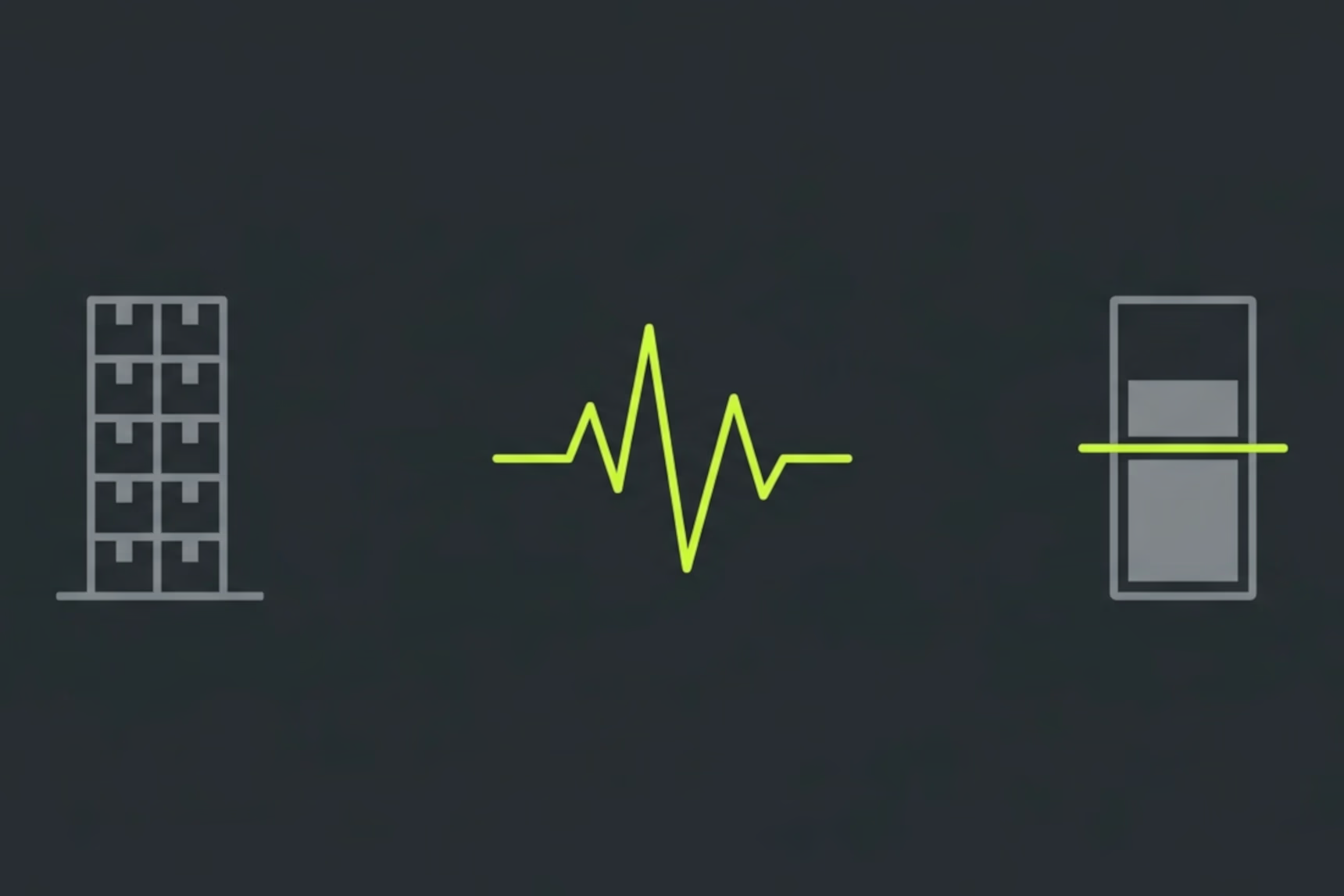
A nurse checks three things to know if a patient is alive and well. Pulse. Breath. Temperature. You can check three things to know if your stock is healthy, and none of them require a system to understand — only to sustain.
The first is stock on hand. What is actually there, right now, today. Not what you think is there. Not what the notebook said last month. What a physical count would find if you walked the shelves this minute. Most owners are surprised, often unpleasantly, when they first compare the two.
The second is stock turnover. This is the pulse. It measures how fast an item sells and gets replaced. Take what you sold of an item over a month, divide it by the average amount you kept on the shelf, and you have its turnover. A high number means the item is alive — moving, earning, returning your cash quickly. A low number means it is barely breathing.
Here is the part that changes how owners think. A shop with less stock that turns quickly almost always beats a shop with a full warehouse that turns slowly. The first shop's money is working. The second shop's money is asleep. Two owners can hold the same value of stock and have completely different businesses — one liquid and fast, the other rich on paper and broke in the bank.
The third is the reorder point. This is the line on the wall that says: when you drop to this level, buy more — now, before you run out. Set it too high and you tie up cash you don't need to. Set it too low, or have none at all, and you meet the woman at the counter with an apology. The reorder point is the difference between a stock-out you saw coming and one that ambushed you.
Three numbers. A count, a pulse, and a line on the wall. Read them and you can feel the health of your stock the way a nurse feels a wrist.
The two enemies

Inventory has two silent enemies. They do not break in at night. They work in daylight, slowly, and by the time you notice them the damage is done.
The first enemy is shrinkage. This is the gap between what should be on the shelf and what actually is. Some of it is theft — by strangers, sometimes by staff. Some of it is honest: breakage, spillage, a sample given away, a miscount at delivery. It does not matter which. What matters is that stock leaves without a sale, and money leaves with it.
You cannot fight shrinkage you cannot see. And you can only see it by comparing two numbers: what your records say you should have, and what a physical count says you do have. When those two numbers drift apart, something is leaking. The owner who counts regularly catches the leak in weeks. The owner who never counts discovers it in a bad year, all at once.
The second enemy is dead stock. This is inventory that has stopped selling. Overbought. Out of season. Overtaken by a newer version. Expired, or close to it. Dead stock is worse than money asleep — it is money dying. It occupies the shelf space a fast-mover could use, it ties up cash you could reinvest, and eventually you sell it at a loss or throw it away.
Dead stock hides because it is quiet. The fast-movers demand your attention every day. The dead stock asks for nothing. It just sits, and costs you, and waits. The only way to find it is to look for the items with a turnover near zero — the ones that have not moved in weeks. That review, done monthly, is one of the highest-paid hours in a small business.
The link you cannot afford to break
Return to the woman who walked to the shop across the road. Why were you out of the item she wanted?
Sometimes it is bad luck. Usually it is a broken link.
Every sale should do two things at once. It should put money in the till, and it should take one unit off the shelf. The money you notice. The unit, you often don't. And when the count on the shelf and the record in the notebook — or the record in your head — drift apart, that gap is exactly where the woman's disappointment came from. You sold your last unit yesterday, the notebook never caught up, and this morning you promised something you did not have.
This is the same gap where shrinkage hides. When sales and stock live in two different places — one in the till, one in a notebook, both a little out of date — the space between them fills with errors nobody chose and losses nobody sees.
The link is simple to describe and hard to keep by hand: a sale is a subtraction. Ring up the item, remove it from the count, in the same motion, every time, without fail. Do that and your stock record is always true. Miss it, even a little, even sometimes, and the record slowly becomes a story instead of a fact.
A stockroom you can read
There is a moment when the shop is quiet and you wonder, genuinely, what you have. Most owners answer that question by walking to the back and looking. It is a slow answer, and by the time you finish, a customer has come and gone.
Imagine answering it from where you stand. Every item, its count, its pulse, its line on the wall — visible in seconds.
Masanchara keeps the link unbroken. Every sale removes its item from the count in the same motion that takes the money. The stock on hand is always current, because it is never reconstructed from memory — it is maintained in real time, one sale at a time. When an item nears its reorder point, you are told before the shelf is bare, not after. When an item stops moving, it surfaces in the slow-mover view instead of hiding in the dark corner of the back room. And when you count the shelves, you compare against a record you can trust, so the gap that reveals shrinkage is a gap you can actually find.
The stockroom stops being a place you walk to and becomes a page you read.
A stockroom you can read from your phone is a stockroom you can trust.
The shelf across the road is not better stocked than yours. It is just better known.